

Dad actually went outside today! He taught me how to attach and run the brush-hog. Hoping to do some on my own my next day off. Let me just tell you, I DO NOT fit on the tractor fender the way I used to!
Dad actually went outside today! He taught me how to attach and run the brush-hog. Hoping to do some on my own my next day off. Let me just tell you, I DO NOT fit on the tractor fender the way I used to!

By Dan Needles
I was in a little arts and crafts shop last week when I heard an earnest young woman with two children in tow grilling the saleswoman about a basket of “densely felted organic dryer balls” sitting in a basket beside the till.
“Are they made of natural fibres?” asked the young woman
“Yes,” said the saleswoman. “They are made entirely of wool. Organic and completely natural.”
“Oh,” said the customer. “I believe in animal rights. After the wool is taken, does the sheep have a good life?”
That stumped the saleswoman. She was not a sheep person and she couldn’t really say. I am a sheep person and I had plenty to say about the life of a sheep. But to my credit, I remained silent. The last time I got dragged into a discussion of sheep’s rights in a public forum, I had a fatwa declared on me and I had to move through a series of safe houses until the whole thing blew over.
All I said was that sheep are a man-made construction, the work of a committee. The sheep committee has been meeting on the third Thursday of the month for the last 5,000 years, ever since the ancient Sumerians started peeling the wool off sheep and spinning the fibres into scratchy sweaters. I pointed out that sheep no longer have a ‘natural’ state.
We have been growing wool on their backs for such a long time that if you don’t shear a sheep regularly, it will often sicken and die. To answer the woman’s question directly, yes, the sheep definitely has a better life sheared than left in its natural state.
This notion infuriates the People for the Ethical Treatment of Animals. They would insist I turn the sheep loose immediately, give it a public apology and set up a trust fund for its needs (which they would supervise, of course). Unfortunately, sheep have been looked after for so long that they can’t survive very long without the attention of a shepherd. This was already true 2,500 years ago and one of the reasons why sheep appeared so often in the Bible. Like people, they need a lot of supervising. Left to their own devices they always get into trouble. Dogs run them to death, wolves sneak in and kill them one at a time, they eat wild cherry leaves and keel over. They roll into holes and can’t get up. They walk over cliffs. If they break through a hole in the fence, they walk into the nearest farm outbuilding and you can just hear them ask, “What’s toxic in here, Marj?”
For the fact is, animals do not have rights. If they did, they would also have responsibilities and that would make a cat a murderer, which is absurd. I am the one with the rights, not the sheep. With my rights comes a set of strict responsibilities, the chief one being an obligation to practice stewardship of all things in my care. Stewardship is a stern and demanding calling and few people understand this more clearly than a shepherd, who practises one of the oldest professions on the planet.
It’s surprising I have anything to do with sheep. Two hundred years ago, my ancestors were tossed off the land during the clearances in Scotland and replaced by sheep, which ate less and could be shorn more often. My forefathers (and the mothers, too) were shipped across the Atlantic in leaky ships and forced to make a new life in places even a sheep would have found unforgiving. No one ever talked about a sheep’s rights in those days. That’s because they were too busy trying to figure out how to protect their own personal human rights without ending up swinging by a rope in a public place.
Today, we have all the spare time required to reflect on any theological question we choose. And we are so well fed that we now have the energy to badger and bully anyone who doesn’t agree with us, even if our beliefs are constructed like a cucumber frame.
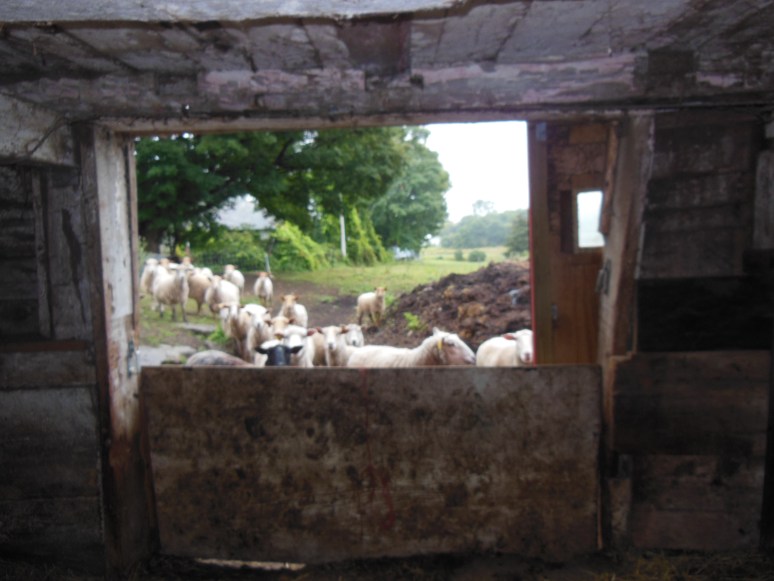
After 30 years with sheep I know that I am obliged to protect them from predators and parasites, bad weather and the poor life choices for which they are famous. In return, I take the wool, which they do not need. Some of them will go into the freezer, but again, all of my efforts are designed to ensure that those sheep only know one bad day. That’s more than a writer gets.
I hope I have cleared up the question of whether a sheep has a good life after the wool is taken. Now, would someone just explain to me what exactly a wool dryer ball is for?


My froggy friend has invited more of his friends to move into the overflow ditch. Hopefully by next summer there will be an entire army of insect eaters living next to the barn. Welcome, friends!

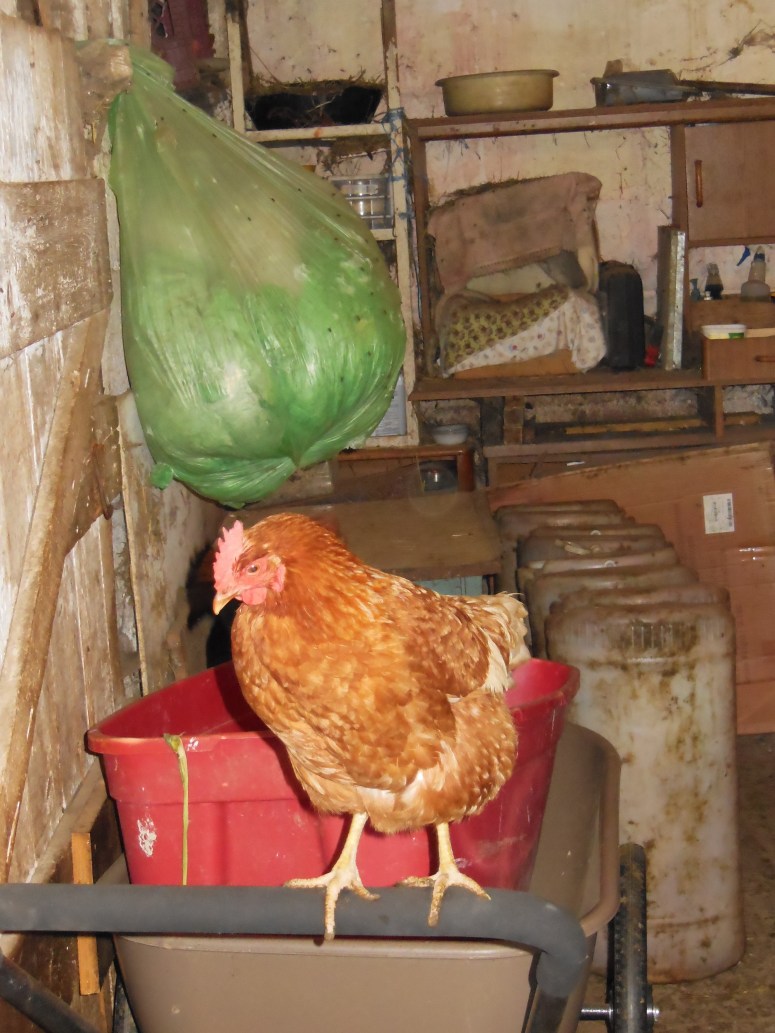
The hens want me to hurry up and feed them. Every day they crowd around me while I mix up their wet mash. They pin me with their eyes. They have a look that is half starved/abused animal straight out of a PETA commercial and half pharaoh commanding his slaves. They want to arouse my pity so that I will rush to rescue them from certain death by malnutrition. At the same time time they want to ensure that will not dawdle or forget my duty in serving their favorite repast. Six against one. The sheep will yell at me over the gate to hurry me along. The hens use this harsher tactic. It can be very intimidating, especially when they start flapping up onto my chair or the feed barrels to oversee my work.


As a treat for the last Keenday before school starts, I took Levi to Dairyland for lunch today. For anyone who went there today and got a sticky table; the pictures above will tell you why. We ate our burgers and fries in my car because Levi was chilly. I AM SO GLAD I put my foot down and we ate our ice cream outside.
In the barn today my little nephew got some hay inside his boots. He sat down and took his boots off to shake the hay out. Teasing, I said, “Pew! I smell stinky feet!” “That’s because I’ve got them,” he replied. He can be so funny sometimes.
When he’s not being a raging pain in the butt, making me wish I could coat him in Preparation H, we have some great conversations. During the course of doing chores tonight our topics of discussion ranged widely. Beginning with a chat about cousins he visited over the weekend we moved on to Nerf guns to bullets to gunpowder to molding musket balls to juice pop molds to him wanting an ice pop.
During the ice pop break we sat down in the sill of the haymow door and got to talking about pigeons, which lead to hawks, which lead to owls, then artificial raptor decoys to scare pigeons away. The conversation then turned to live traps, skunks, and opossums. Then I told him the story of when his mother live-trapped an opossum that had taken up residence in the barn. She didn’t want to hurt it, just relocate it. So, after live-trapping it, she put it in her truck to take it to a new location. And on the drive hit a different opossum that was in the road.
We talked about Hess trucks, my great grandmother’s chickens, the antique horse-drawn plows in the barn, how farmer’s did their work before tractors and electricity. Tractors and what kind of farm he wants to have when he gets big.
I told him how June told me that she missed him and Sissy while they were gone, which lead to me explaining to him how animals communicate with us, even thought they can’t “talk”, then about sign language, what deafness means, blindness and other disabilities. How people and animals overcome such challenges. About the deaf cat and the blind dog we once had.
We talked about his favorite TV show, “The Land Before Time”, dinosaurs, what we would name a rooster if we ever get one, and baby chicks. We told silly knock knock jokes; Knock knock. Who’s there? Water. Water Who? What are you doing here? We talked about what he played with his friends at daycare, what he did on a play date with his friend, and the party his two goldfish are going to have tomorrow night. (Therefore we have to be quiet tomorrow for Keenday, so they can rest.)
I love when we have these rambling talks. If he hears a word of a term he doesn’t understand he wants me to explain, which often leads on strange tangents. I enjoy these kinds of talks with him. Sometimes practical, sometimes silly. Curious and smart. Sometimes wise, sometimes wise-assed. Always fascinating.


 Farmer Keen